Publication of April 20th 2026 Research articleTransition pathwaysA critical review of EU agri-food policy impactsEU agri-food policies are designed to reconcile productivity with environmental, social, and economic sustainability—but do they deliver? Transition pathways governanceExternalitiesLiterature reviewPolicy recommendationsEurope
Publication of January 12th 2026 Research articleTransition pathwaysLiving cover crops alter the fate of pesticide residues in soil: influence of pesticide physicochemical propertiesIn this new scientific article, we show that well-developed cover crops not only reduce nitrogen leaching, but also degrade over a third of pesticide residues in the soil post harvest, and that this effect can be predicted from the physicochemical properties of the pesticide molecules Transition pathways Vegetable sectorCereals sectorProtein cropsPotato sectorBeetroot sectorPesticidesCrop diversificationExternalitiesConservation agriculture
Publication of February 10th 2026 Research articleTransition pathwaysNarratives, trade-offs and scenarios to explore the livestock transition in BelgiumScientific paper exploring different scenarios for the livestock transition in Belgium. The paper illustrates dominant narratives, reveals sustainability trade-offs and reflects on the usefulness of foresight approaches. Transition pathways Protein cropsEggs sectorDairy sectorBeef meat sectorPig meat sectorPoultry meat sectorMeadows and pastureProtein transitionClimate changeBiodiversitySustainability indicatorsPlanetary limitsAnimal feedProspective scenariosEnvironmental footprintBelgium
Publication of January 27th 2026 Research articleProduction systemsDigging deeper: assessing soil quality in a diversity of conservation agriculture practicesConservation Agriculture (CA) aims to enable sustainable crop production and improve soil quality. However, the three CA principles can be implemented in very different ways. Is soil quality consistent across all CA fields? Production systems RotationsOrganic farmingConservation agricultureEnvironmental footprintWallonia
Publication of October 29th 2025 Research articleTransition pathwaysDiversity of agri-environmental governance and potential impacts on environmental performance – a systematic reviewThis study highlights the diversity of Agri-Environmental Schemes (AES) governance across 15 Member States of the EU, and identify governance-related factors influencing AES environmental performance Transition pathways Production systems governanceagri-environmentLiterature reviewEurope
Publication of December 1st 2025 Research articleTransition pathwaysFive methodological updates of the Danish Pesticide Load Indicator to support EU-wide pesticide risk reduction policiesIn this new scientific article, we propose five methodological updates to the Pesticide Load Indicator (PLI) to support pesticide reduction policies in a transparent, scientifically robust manner, harmonised at the European scale. Transition pathways Vegetable sectorFruit sectorCereals sectorProtein cropsPotato sectorBeetroot sectorPesticidesLeversEnvironmental footprintPolicy recommendationsEurope
Publication of October 2nd 2025 Research articleTransition pathwaysA Restatement of the Protein TransitionThis paper seeks to bridge disciplinary silos in the study of the protein transition by bringing together diverse perspectives and insights. Its aim is to foster interdisciplinary and reflexive approaches that can better support transformative change in food systems. Transition pathways Protein transitionEurope
Publication of April 19th 2025 Research articleTransition pathwaysA governance perspective on agri-environmental schemes: Actors, roles, and barriersThis study aims to provide a complementary governance perspective on Agri-environmental schemes (AES). Transition pathways governanceagri-environmentLock-inPolicy recommendationsFrance
Publication of February 28th 2025 Research articleTransition pathwaysWhich types of quantitative foresight scenarios to frame the future of food systems? A reviewPaper published in Agricultural Systems on the use of quantitative foresight scenarios to help design the future of food systems. Different types of scenarios are identified and methodological considerations are discussed. Transition pathways Literature reviewProspective scenarios
Publication of July 17th 2024 Research articleTransition pathwaysThe paradoxes of the protein transition maintain existing animal production and consumption systemsThis perspective paper delves into the Paradoxes of the protein transition, also looking at the socio-technical lock-in of European protein production systems towards animal protein production systems. Transition pathways Protein cropsBeef meat sectorPig meat sectorPoultry meat sectorMeadows and pastureLock-inPolicy recommendationsEurope
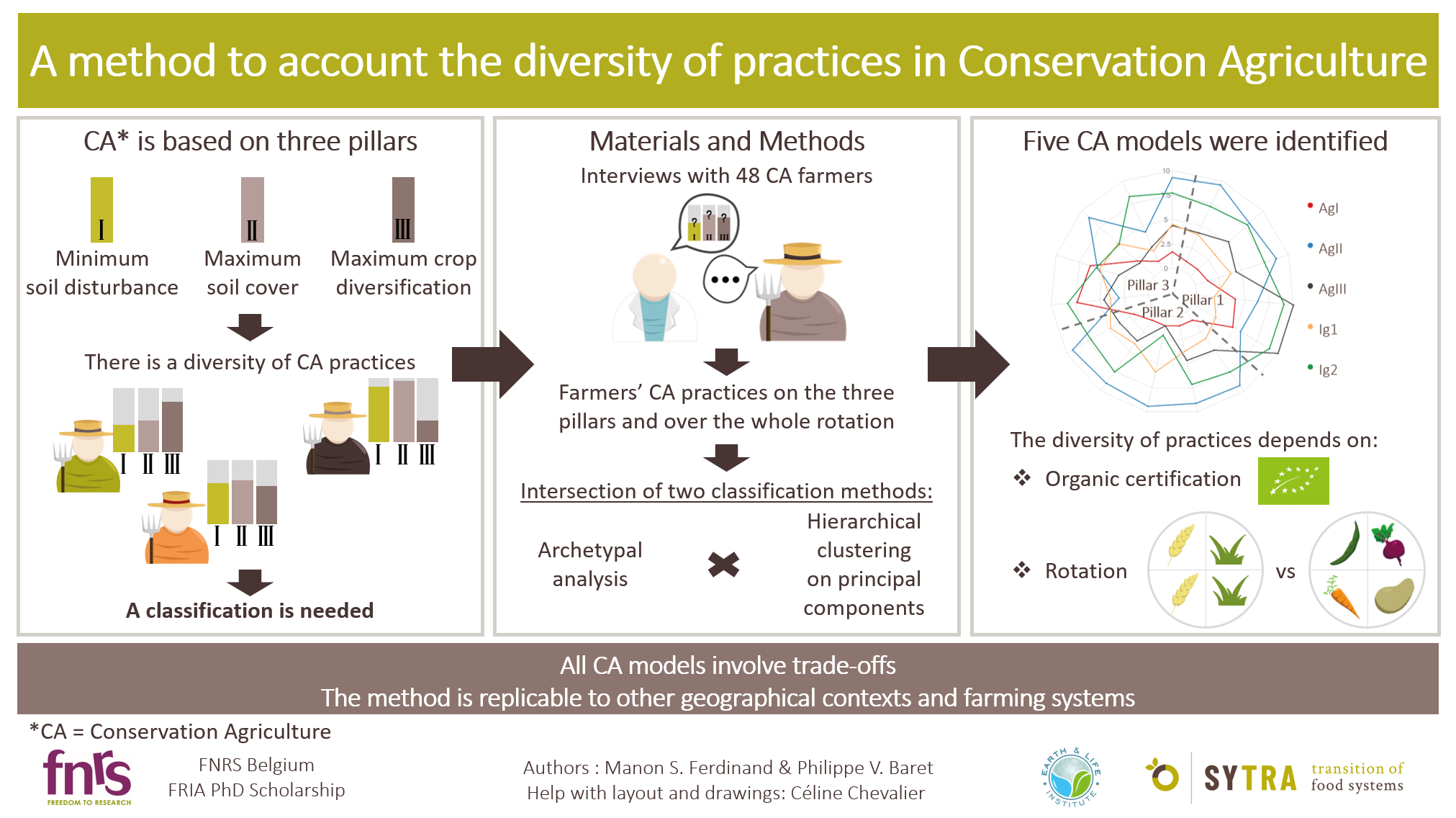
Publication of May 15th 2024 Research articleProduction systemsA method to account for diversity of practices in Conservation AgricultureLocal factors influence the translation of Conservation Agriculture (CA) into practices. To categorize the diversity of farmers’ CA practices, we combined archetypal and hierarchical clustering analysis. In Wallonia, we were able to identify three main CA-types with salient practices. Production systems Crop diversificationConservation agricultureParticipatory approachWalloniaBelgium
Publication of January 3rd 2024 Research articleTransition pathwaysA systematic review of the definitions, narratives and paths forwards for a protein transition in high-income countriesThe article's main findings shed light on the lack of definitions of the protein transition, divergent opinions on protein reduction or replacement in diets, and a notable oversight of systematic change by focusing solely on the nutritional function of proteins. Transition pathways Protein cropsBeef meat sectorPig meat sectorPoultry meat sectorMeadows and pasture